DDD Challenge 2024: What became the 4 winners?
In 2024, four student researchers won the DDD Challenge prize, securing financial support for their projects from Axa. To get an idea of what became of them after winning the prize, we gathered testimonials from the four 2024 winners.
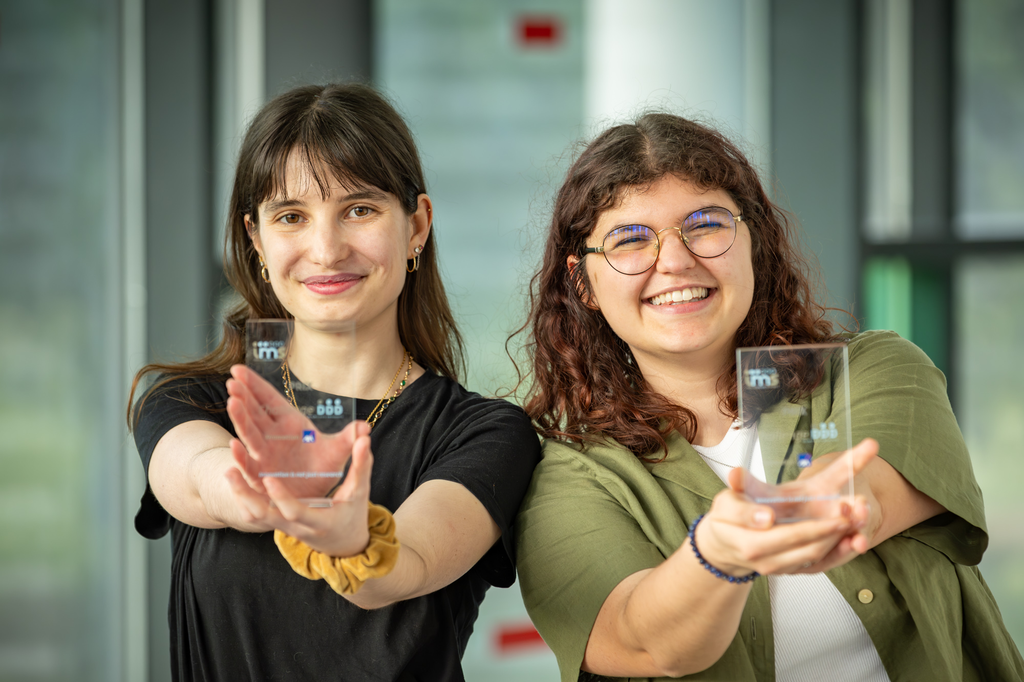
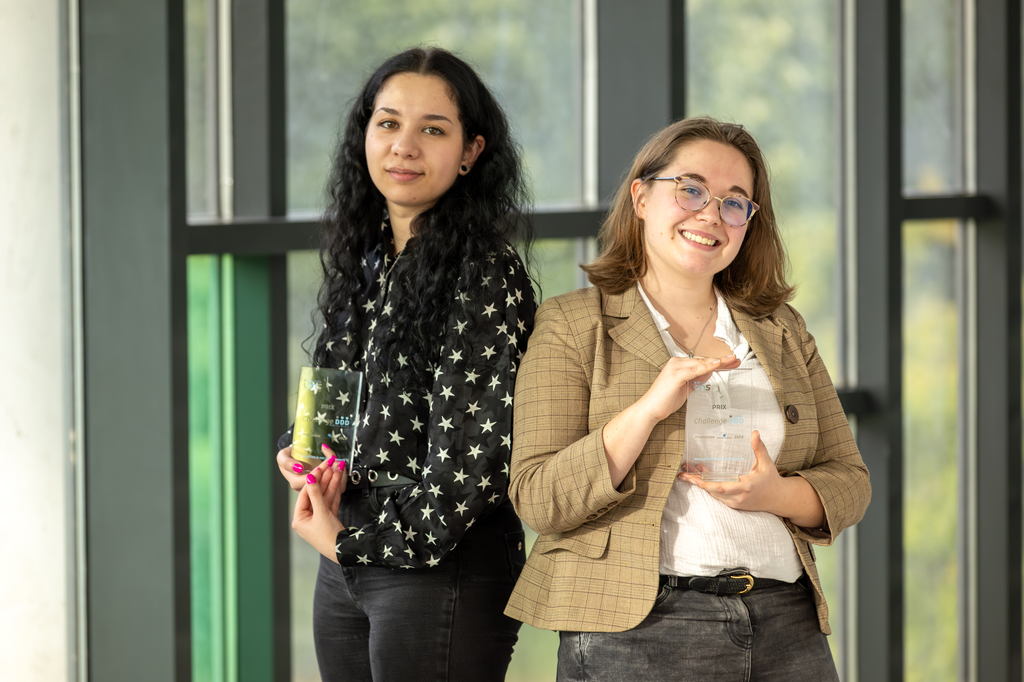
Photo credit: Nicolas Busser
On the left, Elsa Barbé and Sarah Griesbaum Dubour; on the right, Ida Staccioni and Lucie Mazzucotelli: the two winning teams of the DDD Challenge 2024.
1. Which Master's program did you graduate from ?
Ida Staccioni: Master’s degree in Chemistry, Biology, and Medicine from the University of Strasbourg, now called Master’s degree in Chemistry, Biology, and Drug Design
Sarah Griesbaum Dubourg: I graduated with a Master’s degree in “Chemistry and Life Sciences” from the University of Lille.
Elsa Barbé: I completed a dual degree in chemistry and biotechnology at ECPM and ESBS, two engineering schools in Strasbourg.
Lucie Mazzucotelli: I have a Master’s degree in Chemistry with a specialization in Analytical Sciences from the Faculty of Chemistry in Strasbourg.
2. Which research team are you part of (team leader, unit, laboratory)?
Sarah Griesbaum Dubourg: I am part of the “Chemobiology and Pharmacognosy for Health” team at the Therapeutic Innovation Laboratory (UMR7200), and our team is led by Dr. Dominique Bonnet.
Ida Staccioni: BioFunctional Chemistry (BFC) team led by Dr. Guilhem CHAUBET and Dr. Alain WAGNER, from the Synthetic and Therapeutic Chemo-Biology Laboratory, UMR 7199
Elsa Barbé: I am conducting my thesis in a translational research laboratory at the Strasbourg Cancer Institute (ICANS), Dr. Alexandre Detappe’s Nanomedicine Laboratory.
Lucie Mazzucotelli: I currently work at the LSMBO (Laboratory of BioOrganic Mass Spectrometry) under the supervision of Sarah Cianférani. This team is part of the DSA (Department of Analytical Sciences) at the IPHC. We are based on the Cronenbourg campus.
3. Why did you decide to take part in the DDD Challenge?
Sarah Griesbaum Dubourg: Having completed a master’s degree outside the University of Strasbourg, my career path has been somewhat unusual. I discovered the DDD challenge during an M1 internship at the University of Strasbourg, without imagining that I would be able to participate. It was only when I applied to join Dr. Dominique Bonnet’s team that he suggested I apply for the challenge. I accepted immediately, as this is a unique opportunity in France: it is rare to be able to develop your own thesis topic as a student, while incorporating non-scientific aspects such as market research or assessing the patentability of a project. In addition, I began my studies with a bachelor’s degree in chemistry, with the desire to work on topics at the interface of chemistry and biology. The DDD challenge really allowed me to achieve this goal, placing me at the heart of an interdisciplinary project and working closely with my partner, Elsa Barbé (NanomedecineLab, ICANS), who was responsible for the biological part of our work.
Ida Staccioni: I decided to take part in the DDD Challenge because I thought it would be really interesting to try setting up a research project in partnership with someone else, combining chemistry and biology. I think it’s a great opportunity that doesn’t come along very often. I haven’t heard of any other challenges like this!
Elsa Barbé: I was very interested from the moment I read the description of the IMS university degree and its final stage, the DDD Challenge. It’s a great opportunity to be able to develop your own thesis project and discover other aspects besides research itself, such as market research and intellectual property. Being part of this adventure with someone else is a real blessing, as we can support each other throughout the thesis process.
Lucie Mazzucotelli: When I started my master’s degree, I wanted to supplement my academic training with a course that would allow me to learn more about the pharmaceutical industry and drug development. That’s how I found out about IMS and the DDD Challenge.
4. What is your research project and what strategy are you pursuing?
Sarah Griesbaum Dubourg: With Elsa, we are developing a platform for real-time monitoring of immune cell engagers (ICEs). ICEs, a type of immunotherapy, are a particularly promising approach to cancer treatment. They work by physically bringing an immune cell closer to a tumor cell, forming a bridge that promotes the targeted destruction of cancer cells while reducing the side effects associated with less specific treatments such as chemotherapy. However, the development of these molecules remains complex, particularly due to the lack of reliable tools to predict their efficacy at the preclinical stage. Our goal is therefore to create a platform capable of evaluating the potential of drug candidates at a very early stage.
This is done using “turn-on” probes, molecules that only become detectable when they interact with their target. What makes our platform unique is its ability to produce a light signal as soon as the bond between the cancer cell and the immune cell is established. This signal is an essential indicator in preclinical animal model testing: it will enable us to verify that the bond is formed correctly, but also to determine whether our molecules bind specifically to tumor cells without interacting with healthy cells elsewhere in the body. This additional level of control is a major advantage in moving on to clinical trials in humans in a safer manner and with a better chance of success.
Lucie Mazzucotelli: I am working with Ida STACCIONI on the development of innovative RNA-based probes to target a category of proteins that interact with RNA and are frequently deregulated in the body during the development of cancers. More specifically, as these probes are completely new, we need new analytical chemistry methods to characterize them. This is precisely the subject of my thesis: I am currently working on developing liquid chromatography methods coupled with mass spectrometry to obtain as much information as possible about the probes synthesized by Ida.
Ida Staccioni: My project involves synthesizing new RNA-PROTAC probes to target a type of liver cancer. These probes would enable the targeted degradation of a protein that causes and promotes this cancer.
5. What skills have you gained? What difficulties have you had to overcome?
Sarah Griesbaum Dubourg: I have acquired many skills, particularly in comprehension and communication. Working at the interface between chemistry and biology involves mastering concepts from two different fields, but also being able to explain them clearly to non-specialists. I am very lucky to have Elsa by my side: she helps me a lot to understand concepts that can be more difficult for me. The DDD challenge also allows us to develop thinking that goes beyond the strictly scientific framework. For example, we have learned how to manage a budget, think about how to leverage a project through a patent, and even consider creating a startup. The DDD challenge also allows us to develop our oral skills. Personally, I am very uncomfortable when I have to speak in front of an audience: the DDD challenge has helped me enormously to work on this apprehension. Even though I haven’t completely overcome it yet, I’ve learned to manage it better and make my presentations more lively. When speaking in front of the jury, it’s essential to convince them: you have to make them want to listen to you, understand your approach, and believe in your project.
Ida Staccioni: Learning to work as part of a team, conducting bibliographic research in the field, studying the market, and writing a project proposal are among the key skills I acquired during this challenge. I think one of the main difficulties is organization, especially when you have to work in pairs, and the challenge itself is not that simple; writing a project proposal of this type was completely new to us.
Elsa Barbé: The report we had to write for the challenge was similar to a funding application. As a researcher, this experience we were able to gain at such an early stage is a major asset.
Lucie Mazzucotelli: During the DDD Challenge, I got a glimpse of how to write a research project proposal that would make institutions or investors want to support it. It taught me how to construct a clear argument, both in writing and orally. The DDD Challenge gave me the keys to public speaking, even though I am naturally quite shy. The DDD Challenge also taught me how to work under pressure and manage stress, because this project was very important to us and we knew that our competitors were also highly motivated.
6. What are your challenges as a student and the challenges of the project itself?
Sarah Griesbaum Dubourg: The main challenge I face on a daily basis, both as a student and in the context of the project, concerns failed experiments. Sometimes several weeks of work end in negative results, requiring me to repeat the procedures several times. In these situations, it is essential to persevere, learn to cope with these failures, and find solutions to move the project forward.
Ida Staccioni:
As a student, one of the main challenges was organization. The DDD challenge is prepared during the final year of study, either in a master’s program or engineering school, and sometimes the topics of the internship and the challenge differ, which means an increase in workload that can be quite significant.
As for the project itself, the real challenge is to successfully analyze the synthesized probes, which is the subject of my partner Lucie MAZZUCOTELLI’s work. She is developing mass spectrometry methods to characterize the compounds obtained. The next major challenge for the project will be to study the effectiveness of these probes and develop a system to enable their internalization in different types of cells.
Elsa Barbé: The main challenge during the challenge was managing stress and deadlines because the workload was quite heavy. And now, since starting the thesis, the main challenge, as Sarah mentioned, is knowing how to bounce back when experiments fail.
Lucie Mazzucotelli: Of course, there was the challenge of learning to work in tandem with Ida. We learned to communicate and compromise. I am extremely lucky in this regard because Ida is someone I like and respect enormously. We overcame the DDD Challenge together because we are very complementary in the end.
The project itself is subject to the same challenges as a normal thesis project: not all experiments work the first time around, but the most important thing is to learn from your mistakes and know how to bounce back in the right way.
7. What advice would you give to future contestants?
Sarah Griesbaum Dubourg:
I would advise future contestants to take their time choosing their partner and host laboratory. It is essential to know how to work as a team and communicate effectively, as disagreements can arise and you need to be able to handle them calmly. The choice of laboratory is just as crucial: working in a healthy environment where you feel supported makes a huge difference during the months spent on the project. Don’t hesitate to contact the laboratory members in advance to find out, for example, about the quality of supervision and to check whether the team’s working methods match what you are looking for.
Above all, don’t forget to make the most of these months of work. The program offers many opportunities: workshops, dedicated sessions for participants, and of course the challenge day itself. These can be stressful times, but they are also extremely educational and rewarding.
Ida Staccioni: I would advise trying to be as organized as possible, not hesitating to contact people in the field to ask questions, and above all choosing a subject that appeals to them.
Elsa Barbé: I would advise future participants to choose their partner and laboratory carefully, as writing a thesis involves many challenges. It is essential to have an environment where you feel comfortable, with people who allow you to unwind when the work gets tough.
Lucie Mazzucotelli: I would say surround yourself with the right people. A good support network can really revolutionize your approach to the DDD Challenge. This obviously involves choosing the right partner, but also the people who will support your project. In our case with Ida, we are lucky to have two research directors (Sarah Cianférani and Guilhem Chaubet) who support us on a daily basis and who have been true mentors throughout this Challenge. This great victory is also theirs, as they have been very invested in our project.
Thanks to all of the four winners of this scientific challenge for taking the time to answer our questions! Their experience and lessons learned throughout this challenge are a true source of inspiration for science and chemistry students, as well as for our IMS university degree students.